BlueSci Issue 64 — The Universe as a Story We Keep Rewriting
Contributing author to the 64th Issue of BlueSci, the University of Cambridge's longest-running science communication magazine
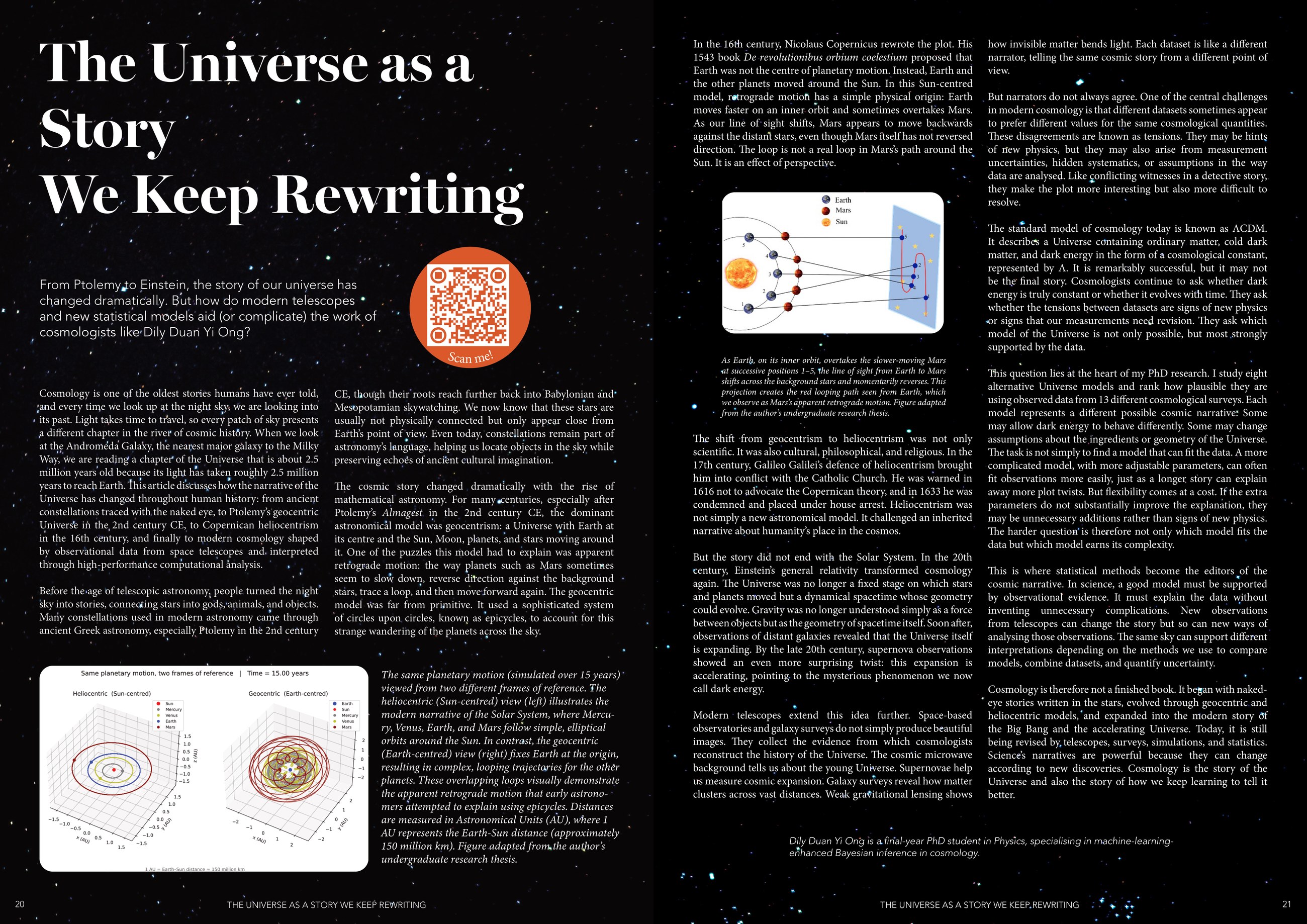
I am a contributing author to Issue 64 of BlueSci, the University of Cambridge’s longest-running science communication magazine. My article, “The Universe as a Story We Keep Rewriting” (pages 20–21), asks what it means that cosmology has never been a settled account of the cosmos, but one we have revised in every century we have been able to look up and measure.
Every time we look up at the night sky, we are looking into its past.
Light takes time to travel, so every patch of sky is a different chapter in the river of cosmic history: the light we receive from Andromeda, our nearest major galactic neighbour, left it roughly 2.5 million years ago. The article follows how the narrative built from that light has been rewritten again and again — from constellations traced with the naked eye, through Ptolemy’s geocentric Universe and its ingenious system of circles upon circles, to Copernicus placing the Sun at the centre and turning the baffling backwards loop of Mars into a simple matter of perspective. That shift was never only a scientific one: Galileo was condemned and placed under house arrest in 1633 for defending it, because heliocentrism unsettled an inherited story about humanity’s place in the cosmos.
In the 20th century, Einstein’s general relativity rewrote the plot again. The Universe stopped being a fixed stage on which stars and planets moved and became a dynamical spacetime whose geometry could evolve — and observations of distant galaxies soon revealed that this spacetime is expanding, with supernovae later adding a stranger twist still: the expansion is accelerating, driven by what we now call dark energy.
Modern telescopes and galaxy surveys extend that idea. They do not simply produce beautiful images; they collect the evidence from which the history of the Universe is reconstructed. The cosmic microwave background reports on the young Universe, supernovae measure its expansion, galaxy surveys map how matter clusters, weak gravitational lensing traces matter we cannot see. Each dataset is a different narrator telling the same story from a different vantage point — and, like conflicting witnesses in a detective story, they do not always agree. Those disagreements, known as tensions, may be the first hints of new physics, or they may be artefacts of measurement uncertainty, hidden systematics, or the assumptions folded into our analyses.
The piece closes on the question at the heart of my PhD research: I rank eight alternative Universe models against data from 13 cosmological surveys, each model a different possible cosmic narrative. Finding a model that fits the data is the easy part — a more flexible model, with more adjustable parameters, can often fit observations more easily, just as a longer story can explain away more plot twists. The harder and more interesting question is not which model fits, but which model earns its complexity. Cosmology, in other words, is not a finished book: it is still being revised by telescopes, surveys, simulations, and statistics. It is the story of the Universe, and also the story of how we keep learning to tell it better.
Official link to Cambridge BlueSci Issue 64